What Your Egg Carton Is Actually Telling You
A simple guide to Australian egg labels - what they legally mean versus what most people think they mean.

I picked up a carton of eggs at Woolies the other week and stood there longer than I'd like to admit, staring at the label. "Free range." Picture of a hen in a sunny paddock. Sounds lovely. But I'd heard enough over the years to know the picture and the reality don't always match up, and I wanted to actually understand what I was buying.
So I did the reading so you don't have to. Here's every label you'll come across in an Australian supermarket, what it legally means, and what's actually going on.
Caged eggs
These are exactly what they sound like. Hens spend their lives in wire battery cages inside large sheds. Each hen has roughly the space of an A4 sheet of paper. They can't spread their wings, dust bathe, or do much of anything that comes naturally to a chicken. These are still legal in Australia and still make up a significant chunk of supermarket sales. At least the label is honest.
Barn-laid (also called cage-free)
You'll see both "barn-laid" and "cage-free" on Australian cartons and they mean the same thing. Hens live in large indoor sheds without cages, so they can move around, perch, and socialise with other birds. No outdoor access is required, ever. The shed can have multiple levels. Up to nine hens can share a single square metre indoors.
Barn-laid eggs are increasingly common as major supermarkets phase out cage eggs. It's a genuine step up from caged, but "cage-free" sounds freer than it is. These chickens have never seen the sky.
Free range
This is where most people get caught out, and honestly, where I got caught out too.
Under Australian law, free range means hens must have "meaningful and regular access" to an outdoor range during daylight hours. The shed doors are opened each morning. That part is real. But the legal maximum outdoor stocking density is 10,000 hens per hectare, which works out to one square metre of outdoor space per hen. That outdoor area isn't required to be rotated or managed, so it often becomes a bare patch of dirt after the hens have scratched it to pieces.
There's also no requirement for hens to actually go outside, only that the doors are open. In large commercial sheds where the exit space might be just 35cm high and serve hundreds of birds, many hens simply never make it out even if they wanted to.
The saving grace is that free range cartons must display their outdoor stocking density. That number is worth checking. A farm running 1,500 hens per hectare and a farm running 10,000 hens per hectare can both legally call their eggs "free range," but they're very different operations. The CSIRO's own research suggests 1,500 per hectare is the point at which outdoor access is genuinely meaningful.
Pasture raised
Pasture raised is technically a type of free range. Any pasture-raised egg also meets the free range standard, but not the reverse. The difference is significant.
Pasture raised means hens live in mobile shelters (sometimes called caravans or chicken tractors) that are moved regularly onto fresh grass. Because the land is rotated, stocking densities are much lower, typically around 1,500 hens per hectare or fewer. The hens are actually foraging on living pasture: bugs, worms, seeds, real ground cover. It's closer to what most people picture when they imagine "free range."
The catch is that "pasture raised" isn't a legally protected term in Australia the way "free range" is. Any producer can put it on a carton without meeting a defined standard. This is why it's worth doing a little homework on the brand. Some farms carry the PROOF logo (Pasture Raised On Open Fields), which requires an annual audit and caps density at 1,500 hens per hectare. But not every genuine pasture-raised operation has it. Certification costs money and involves ongoing paperwork, and some smaller farms simply operate at a standard that far exceeds what any certification requires, they just haven't paid for the logo.
The Watson Family Produce eggs I buy, for example, run 120 hens per hectare, use mobile shelters, rotate pasture regularly, and don't use any chemicals, antibiotics or GMOs. Their practices are publicly detailed on their website and social media. You won't find the PROOF logo on the carton, but you also won't find many certified operations running at 120 hens per hectare.
So with pasture raised, the logo is a useful shortcut if you don't have time to look into it further. But transparency is just as telling. If a farm can't tell you their stocking density, where they're located, and how often they move their birds, that's worth noting.
And yes, a carton can say both "free range" and "pasture raised." That's not contradictory. Pasture raised is simply a higher bar within the free range category. Seeing both on the same label usually means the producer is proud to meet both standards.
Certified organic
Organic eggs must come from hens raised without synthetic pesticides, herbicides, antibiotics or genetically modified feed. They're also required to have outdoor access, so they meet at minimum the free range standard.
The word "organic" alone on a carton can be misleading though. It could technically mean barn-raised hens fed organic grain, no outdoor access, just a cleaner diet. The certification logo is what actually matters here. Look for Australian Certified Organic or a similar third-party accreditation. Without it, "organic" is just a word on a box.
The quick comparison
Here's how the systems stack up side by side:
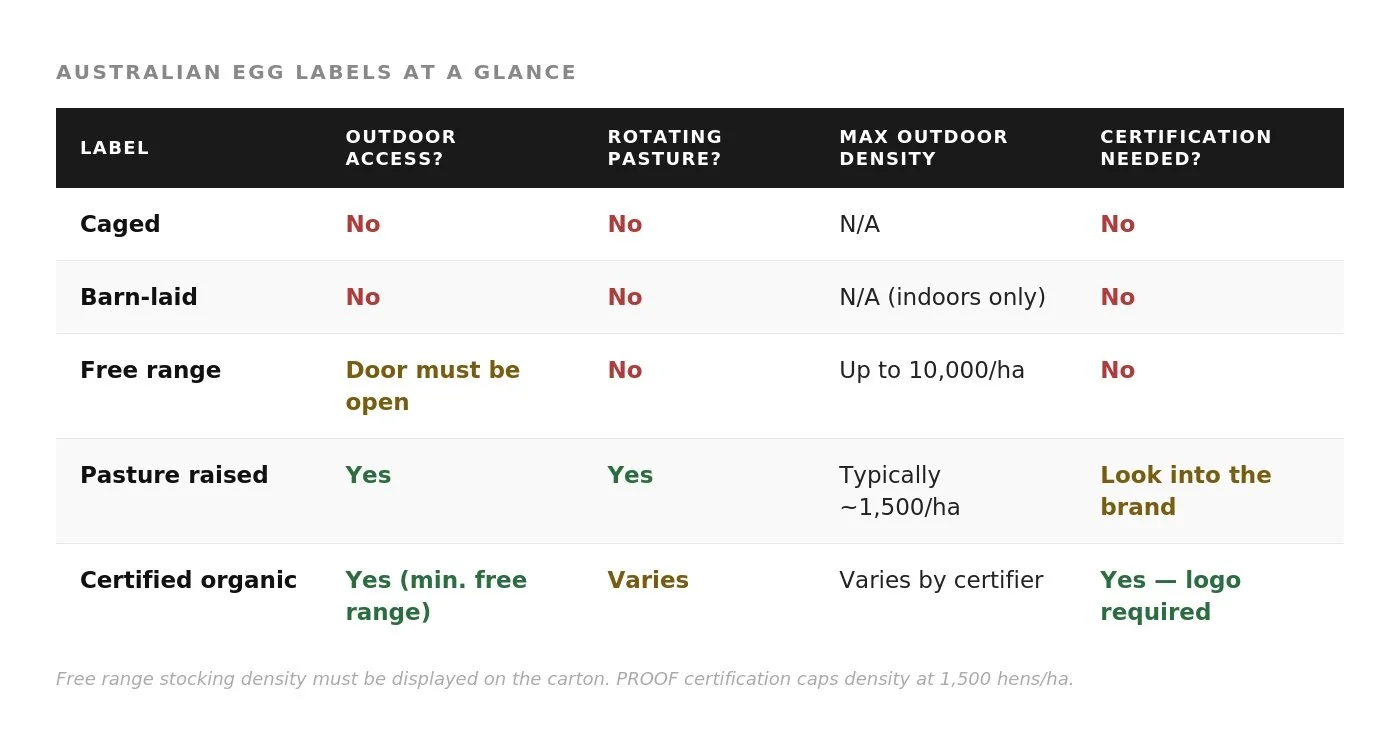
Comparison table of Australian eggs
The words that mean nothing
A few things you'll see on cartons that sound meaningful but have no legal definition and no bearing on how the hens were raised: farm fresh, natural living, country raised, hen happy, no de-beaking, Australian grown.
Every carton egg sold in Australia is laid in Australia, so "Australian grown" is redundant. Beak trimming is still permitted across all production systems, so "no de-beaking" may or may not be accurate but tells you nothing about the farming conditions. And "farm fresh" means absolutely nothing at all.
So what should you actually look for?
If hen welfare is something you care about, the most useful things to check are the stocking density number on any free range carton (lower is better, 1,500 per hectare or fewer is genuinely good), and whether you can find out anything about the brand behind a pasture raised claim.
None of this means you need to spend a fortune on eggs every week. But it helps to know what you're actually paying for and what the label is and isn't promising, so you can make that call for yourself.
Note: All information refers to Australian labelling law. The legal maximum for free range outdoor stocking density is 10,000 hens per hectare under the Free Range Egg Labelling Information Standard 2017. PROOF certification caps density at 1,500 hens per hectare.