Psyllium Husk vs PHGG: What's the Difference?
Psyllium husk is having a moment (and fibre deserves it). But as a nutritionist, it's actually not the fibre I recommend to my clients. Here's what I reach for instead, and why.

First, let's talk about psyllium
Psyllium husk has earned its reputation. It's a well-researched soluble fibre with genuine benefits. It supports bowel regularity, helps lower LDL cholesterol, aids oestrogen clearance, and works well for a lot of people. The current interest in it on social media is not wrong.
But for clients with sensitive guts, SIBO, or histamine sensitivity, I find myself consistently reaching for something else - Partially Hydrolysed Guar Gum, or PHGG. And the reasons why come down to a few clinically meaningful differences that are worth understanding.
What is PHGG?
PHGG stands for Partially Hydrolysed Guar Gum. It's a soluble dietary fibre derived from guar beans that has been extensively studied for gut health. Unlike psyllium, it is completely tasteless and odourless, dissolves fully in liquid with no gritty texture, and is one of the few fibres with Level 1 clinical evidence - meaning it has been validated through randomised controlled trials and meta-analyses - for constipation, diarrhoea, and IBS.
It also acts as a prebiotic, feeding beneficial gut bacteria. But more on that shortly.
What psyllium and PHGG have in common
Before getting into the differences, it's worth being clear about where they overlap, because psyllium does a lot of things well:
Both support bowel regularity
Both support oestrogen clearance through the bowel, which has implications for hormonal balance and skin health
Both are prebiotics (they feed beneficial gut bacteria)
Both require a slow introduction, i.e. starting low and building gradually is important with either fibre to avoid digestive discomfort
The oestrogen clearance point is one I want to highlight specifically, because it sometimes gets attributed only to PHGG in wellness content. Soluble fibre in general, including psyllium, binds to excess oestrogen in the digestive tract and helps clear it through the bowel. When bowel motility is sluggish, oestrogen gets reabsorbed rather than excreted, which can contribute to hormonal skin flares, PMS symptoms, and other signs of oestrogen dominance. Both fibres support this process.
Where PHGG goes further
1. It works for both constipation and diarrhoea
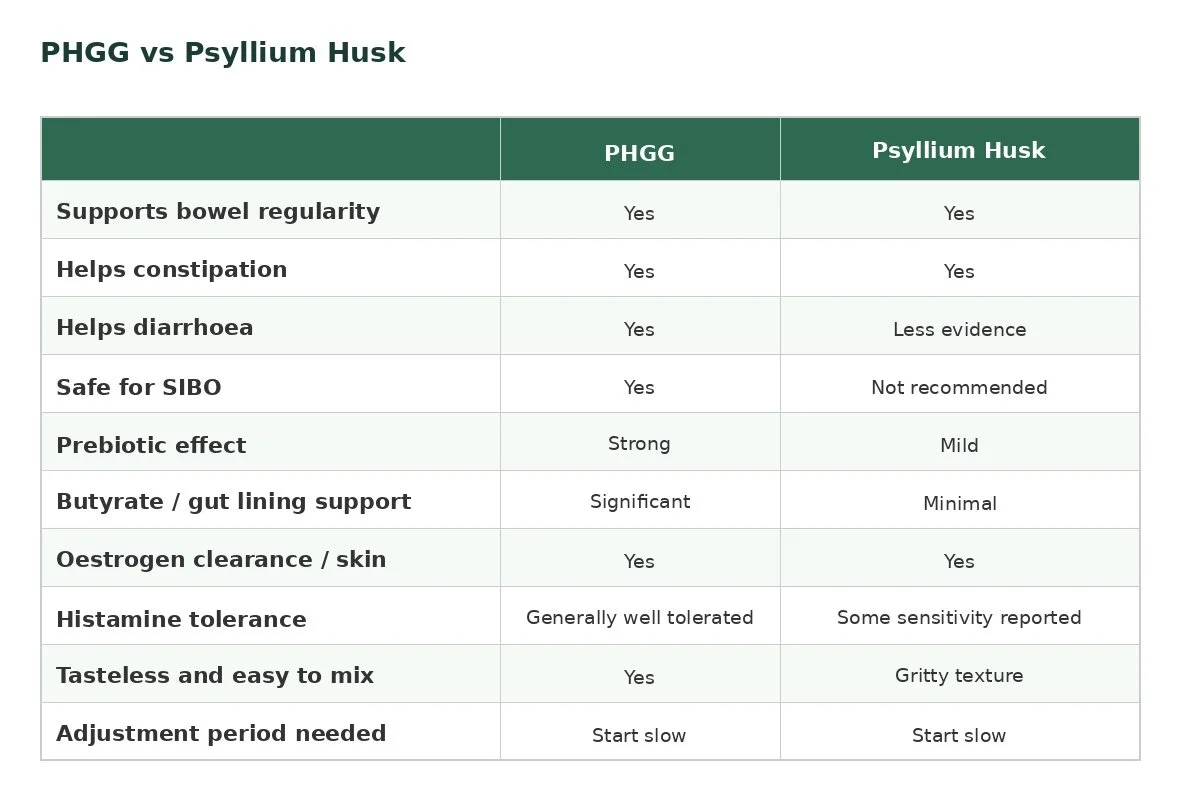
Psyllium is well established for constipation. PHGG has clinical evidence for both constipation and diarrhoea - it regulates gut motility rather than pushing in one direction. For anyone with “IBS” or unpredictable digestion, this bidirectional effect is a significant advantage. Clinical trials have shown PHGG decreases symptoms in both constipation-predominant and diarrhoea-predominant IBS, as well as improving bloating and gas scores compared to placebo.
2. Stronger prebiotic effect and more butyrate
Both psyllium and PHGG are prebiotics, but the degree to which they're fermented, and what that fermentation produces, differs meaningfully.
Psyllium is only partially fermented by colonic bacteria, which is actually part of why it's well tolerated for gas-prone individuals. Less fermentation means less gas. But it also means less butyrate production.
PHGG is more actively fermented, specifically stimulating bacteria like Bifidobacteria and butyrate-producing species in the large intestine. Butyrate is the primary fuel source for colonocytes, the cells lining the colon. It plays a critical role in:
Maintaining and repairing the gut lining
Reducing intestinal permeability (leaky gut)
Reducing inflammation in the gut
Research has directly compared PHGG and psyllium for butyrate production, with PHGG producing significantly more. This is one of the most clinically meaningful differences between the two.
3. Safe for SIBO (one of the only fibres that is)
This is the biggest differentiator, and the one I come back to most in clinical practice.
Small Intestinal Bacterial Overgrowth (SIBO) is a condition where bacteria that should be confined to the large intestine end up overgrowing in the small intestine. One of the key dietary challenges with SIBO is that most fibres ferment too quickly and too high up in the gut, feeding the overgrowth rather than helping it.
Psyllium is generally not recommended during active SIBO for this reason. PHGG is an exception. Because it ferments slowly and specifically in the large intestine, it doesn't aggravate bacterial overgrowth. It has been studied alongside SIBO treatment protocols, and when combined with antibiotic treatment, SIBO eradication rates improved significantly compared to antibiotics alone.
For anyone who has been through SIBO treatment and is rebuilding their gut, or who suspects SIBO may be a factor in their symptoms, fibre choice matters enormously here.
4. Histamine sensitivity
Psyllium is generally considered low histamine and is fine for most people. However, some individuals with reactive or sensitive immune systems report that it doesn't agree with them. And not because it's high histamine, but potentially due to mast cell reactivity in sensitive systems.
PHGG tends to be better tolerated across the board for people managing histamine load, though individual responses always vary. If you've tried psyllium and noticed it seems to trigger symptoms you can't explain, it may be worth trying PHGG instead.
5. Easier to take long-term
This one is practical but worth mentioning. Psyllium forms a gel when mixed with water and has a distinct gritty, mucilaginous texture that puts a lot of people off consistent use. PHGG is completely tasteless and dissolves without any texture change. It can be stirred into water, a smoothie, or even coffee without affecting the taste or consistency.
Long-term compliance matters with any supplement. If you're going to take it every day, it helps if it's easy.
PHGG vs Psyllium
How much PHGG and when
Getting the dose right matters. Even though PHGG is well tolerated, starting too high can still cause some digestive adjustment.
Start low: begin with 2–3g per day (roughly half a teaspoon) and build gradually over 2–3 weeks
Therapeutic dose: most studies use 5–6g per day, in one or two servings
Timing: can be taken at any time, with or without food
How to take it: stir into water, smoothies, or coffee (it dissolves completely and doesn't affect taste or texture)
Hydration: as with any fibre, adequate water intake throughout the day is important
If you're managing SIBO specifically, it's worth discussing timing with a practitioner. Some protocols introduce PHGG after the initial treatment phase rather than during it.
Who is PHGG best suited for?
PHGG is a good option for most people adding a fibre supplement, but it's particularly well suited for:
People who've tried psyllium and experienced persistent bloating or cramping
Those with “IBS” (constipation, diarrhoea, or mixed)
Anyone with SIBO or a history of SIBO
People with histamine sensitivity or reactive immune systems
Those dealing with hormonal skin concerns or signs of oestrogen dominance
Anyone wanting to support gut lining integrity and reduce gut inflammation
Psyllium remains a solid choice for people without these considerations, particularly for straightforward constipation or cholesterol support. The goal here isn't to dismiss it, it's to make sure the right fibre is matched to the right person.
A note before you start
Gut health is individual, and fibre is a powerful tool that works best as part of a broader picture. Diet quality, hydration, stress, and sleep all play a role. If you have a diagnosed condition like SIBO, IBD, or a complex digestive history, working with a practitioner to personalise your approach will always get better results than supplementing in isolation.
Want support that's specific to you?
I work with clients one-on-one to get to the root cause of gut symptoms, skin concerns, and hormonal imbalances, and build a plan that actually fits your life. Consultations are available online.